Saturday, 9 June 2018

energy fuel in comparison with lithium ion battery energy

gasoline is the champion at 47.5 MJ/kg and 34.6 MJ/liter; the gasoline in a fully fueled car has the same energy content as a thousand sticks of dynamite. A lithium-ion battery pack has about 0.3 MJ/kg and about 0.4 MJ/liter (Chevy VOLT). Gasoline thus has about 100 times the energy density of a lithium-ion battery. This difference in energy density is partially mitigated by the very high efficiency of an electric motor in converting energy stored in the battery to making the car move: it is typically 60-80 percent efficient. The efficiency of an internal combustion engine in converting the energy stored in gasoline to making the car move is typically 15 percent (EPA 2012). With the ratio about 5, a battery with an energy storage density 1/5 of that of gasoline would have the same range as a gasoline-powered car. We are not even close to this at present.Powering a car with electricity is considerably more efficient than powering a car with gasoline in terms of primary-energy consumption. While the efficiency of energy use of an electric car is very high, most power plants producing electricity are only about 30 percent efficient in converting primary energy to electricity delivered to the user. Conversion of petroleum to gasoline is highly efficient. This results in electricity having a factor of 1.6 improvement in use of primary energy relative to gasoline, and is an important point in its favor.A 2008 APS report on energy efficiency examined statistics on how many miles Americans drive per day. The conclusion of that study was that a full fleet of PHEVs with a 40-mile (60-km) electric range could reduce gasoline consumption by more than 60 percent. Thus America may not need a full fleet of BEVs to achieve a very considerable reduction in gasoline use.

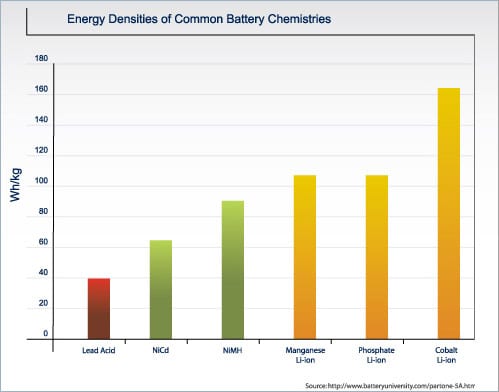
densities chart
Energy densities of common batteries
Cathode materials are comprised of cobalt, nickel and manganese in the crystal structure forming a multi-metal oxide material to which lithium is added. This family of batteries includes a variety of products that cater to different user needs for high energy density and/or high load capacity. The table below breaks down the most commonly used Lithium-ion battery cathode chemistries on the market into four groups: Cobalt, Manganese, NMC and Phosphate.

Friday, 15 April 2016

WiFi radiation measurement methods and preventive fabric details

Collection of some useful weblinks for radiation safety of human health, due to exposure of high frequency wireless environment, were given below
www.4ehsbyehs.com/rf-blocking-fabrics
Electromagnetic Hyper Sensitivity(EHS) affected persons usually feel paid in ears or headache with little time of exposure with cell phone usage
radio frequency radiation
Map WiFi coverage and make it faster software is freely downloadable with limited time version

EMF "Safety standards" not so safe

A Safety Standard is a problematic term. Safety standard are set by a committee of experts who tried to validate how much radiation is safe and how much is not safe. In the process of setting the standard many aspects, other then safety or health, are taking into consideration. For example: financial, technical and political. Sometimes when you can not technically meet the standard, or meeting it will result in financial cost, the standard is gently shifted to please everyone and to save money. The international standards for low (used to be 1000 milliGauss, since 2005 it is 2000mG) and high frequency(1000-400 micro watts square centimeter) electromagnetic radiation are very high. Both takes into account only the immediate, obvious and permanent damage to the body and does not take into account any long-term or biological effects. Some companies and organizations will use these outrageous high so called "safety standards", without explanation of the true essence of it and its limitations. 

Assessment of the exposure load

  1. Number of signal on the frequency span
  2. The level-strength of the signals
  3. Exposure time
Lets take for example the exposure of a person to EMF radiation from a mobile phone. The phone can emits several frequencies (RF) while transmitting. In addition it will emits some levels of ELF.  We don't have control over the number of frequencies emitted, but we should take that into consideration while assessing the exposure load (and while doing the measurement). The radiation level can be partially and roughly measured using and EMF meter, just keep in mind that you are not measuring all of it. The radiation level can be controlled by using the phone in open environment (not in elevators, trains, cars or indoors) where the reception is better and where the phone will emit less RF radiation. In addition using the speaker phone function or a wired earpiece will reduce the exposure even more. The time of exposure can be easily assessed and reduced buy keeping the conversation short and to the point. 

Duty Cycle


Multi frequency and multiple sources measurements

Please note that most of the High-frequency electromagnetic radiation meters that I encountered to date (both professional and simple) are not able to measure multiple frequencies and multiple radiation sources correctly (mobile, WIFI, cellular antennas, cordless phones, etc.). This limitation is due to the difficulty of measuring and summing up all the radiation levels in all the frequencies. Therefore the measurement of radiation sources that emit RF radiation in several frequencies (eg: WIFI, mobile phone antennas mailman third or cellular) or measuring several radiation sources at once may not be accurate and the results will generally be lower than the radiation levels in reality. It is still possible to use these meters to expose radiation sources and to understand how to shield and how to reduce your exposure from them. The only why to measure multi-frequency and mutli-sources environment is by using a vary fast spectrum analyzer.